

The importance of natural preservation today
Consumers today want food that is both safe and simple: free from synthetic additives, but still well protected against spoilage. This puts natural preservation high on the food industry's agenda. People read ingredient lists and prefer clean-label products, and regulators and retailers keep tightening the rules on artificial preservatives. At the same time, food preservation remains essential for food safety and for cutting the amount of food lost to spoilage. Naturally derived systems answer this need. Nature already contains a rich source of inspiration such as vinegars made via fermentation or plant antioxidants such as tea polyphenols. The mission of food scientists today is to find a way to marry these natural solutions with modern food technology and customer needs.
Galactic's patented infused flavor technology
When it comes to harvesting the richness, nature offers us in the form of herbs and spices, many products on the market focus on the oil-based or oil-soluble compounds of these herbs and spices. However, Galactic makes use of a technology that allows efficient extraction of water-soluble compounds from herbs and spices [1]. Getting these water-soluble actives out at scale is exactly what Galactic's patented method does, and it does so without organic solvents. First, an acidic fermentation product is neutralized to obtain a powerful solvent for extracting essential flavor and functional compounds from herbs and spices. This extraction is achieved by infusing the herb or spice, fresh, dried or dehydrated, in this solvent for a few minutes up to about 24 hours, at mild temperatures from ambient to around 50 °C/120 °F. After filtration, the extract is recovered as a liquid or spray-dried to a powder. The method gives a higher yield; very little loss of aroma and adjustable intensity compared to other extraction methods.
Galactic has already launched Flavor products to enhance the taste and freshness of food products based on basil, oregano and clove. Thanks to its subsidiary in China, the Galactic innovation team is now tapping into the power of green tea.
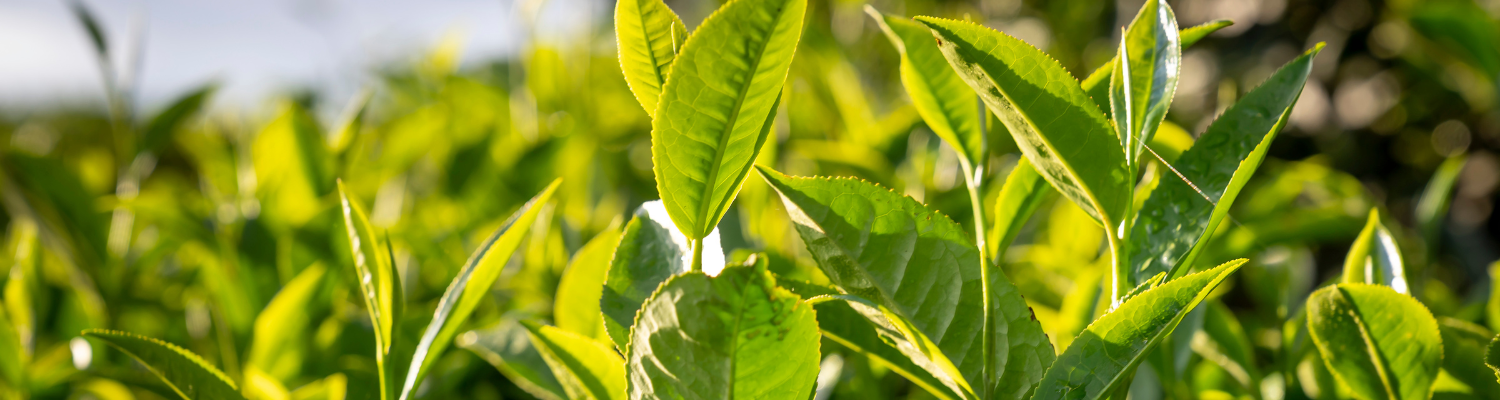
Chinese green tea as a source of inspiration
The use of green tea (Camellia sinensis) for all the benefits it boasts is not new. Green tea's health reputation was already written down in China more than 1,250 years ago, in Lu Yu's Cha Jing (The Classic of Tea, 760–762 CE), the world's first book on tea, and its medicinal use goes back even further to the legendary Shennong [2]. Modern research backs this up and has identified multiple molecules present in green tea that act as strong antioxidants and free-radical scavengers, compounds that lower LDL cholesterol, blood sugar and blood pressure and reviews also support L-theanine's role in reducing stress and anxiety [3-6].
Green tea is a very good fit for gentle, water-based extraction because its most useful components are water-soluble and pass easily into a warm or hot water extract. The main actives are the catechins, the flavan-3-ols epigallocatechin gallate (EGCG), epicatechin gallate, epigallocatechin and epicatechin. They make up about 25 to 35% of the leaf's dry weight, and EGCG alone accounts for roughly half of the total polyphenols [2,3]. These catechins are in fact more soluble in water than in ethanol or methanol, which is why traditional hot-water brewing works so well [7]. Next to them, you find L-theanine, a water-soluble amino acid typical of tea (about 6.6 mg/g, highest in green tea), together with caffeine, flavonol glycosides, gallic acid [8], vitamin C and tea polysaccharides [9].
Because Galactic’s extraction method is a mild, water-based infusion, it picks up the water-soluble components, which are exactly the part of green tea that carries the benefits. Furthermore, the use of mild temperature ensures maximal protection of heat-sensitive compounds such as vitamin C and limits the breakdown of catechins.
Bringing it all together
By combining Galactic infusion technology with the power of green tea, we can offer customers a clean-label route to both flavor and natural protection via a single clean-label ingredient. Since putting a new product on the market is only half the work, Galactic’s innovation team is ready to explore how these infused flavors can become a partner to your product range by studying application trials, checking shelf life and safety in our physicochemical and microbiological labs, and supporting you on clean-label positioning and regulatory questions, from the first sample to the finished launch.
Author: Pieter Van der Weeën, Corporate R&D Director
References
1. Method for Preparing an Extract of Herb(s) and/or Spice(s) from a Vinegar Salt. BE 2021/5877, November 12, 2021
2. Lu Yu. The Classic of Tea (Cha Jing), 760–762 CE (Tang dynasty). See Carpenter FR (transl.), The Classic of Tea, Little, Brown & Co., 1974.
3. Musial C, Kuban-Jankowska A, Gorska-Ponikowska M. Beneficial Properties of Green Tea Catechins. International Journal of Molecular Sciences. 2020;21(5):1744. doi:10.3390/ijms21051744
4. Capasso L, De Masi L, Sirignano C, et al. Epigallocatechin Gallate (EGCG): Pharmacological Properties, Biological Activities and Therapeutic Potential. Molecules. 2025;30(3):654. doi:10.3390/molecules30030654
5. Li M-Y, Liu H-Y, Wu D-T, et al. L-Theanine: A Unique Functional Amino Acid in Tea (Camellia sinensis L.) With Multiple Health Benefits and Food Applications. Frontiers in Nutrition. 2022;9:853846. doi:10.3389/fnut.2022.853846
6. Zamani M, Rezaei Kelishadi M, Ashtary-Larky D, et al. The effects of green tea supplementation on cardiovascular risk factors: a systematic review and meta-analysis. Frontiers in Nutrition. 2023;9:1084455. doi:10.3389/fnut.2022.1084455 (PMID: 36704803)
7. Hwang H-J, Kim Y-G, Chung M-S. Improving the Extraction of Catechins of Green Tea (Camellia sinensis) by Subcritical Water Extraction. Foods. 2021;10(12):3092. doi:10.3390/foods10123092
8. Lin L-Z, Chen P, Harnly JM. New Phenolic Components and Chromatographic Profiles of Green and Fermented Teas. Journal of Agricultural and Food Chemistry. 2008;56(17):8130–8140. doi:10.1021/jf800986s
9. Yao J, Liu H, Ma C, et al. A Review on the Extraction, Bioactivity, and Application of Tea Polysaccharides. Molecules. 2022;27(15):4679. doi:10.3390/molecules27154679

Still have questions?
Can’t find the answer you’re looking for?
Contact us for expert advice and support!