

Food spoilage microorganisms
Today, through DNA analysis methods called metagenomic analyses, it is possible to precisely identify the microorganisms capable of degrading food products and thus reducing their shelf-life. For those readers wanting to know more on how this technique works, we refer to a previously published article.
Although there are many techniques available to food technologists to preserve food, one important technique is to use food preservatives that have the ability to inhibit the growth of these spoilage microorganisms and allow the food product to retain all its quality for an acceptable time.
When we look a bit closer, we can distinguish two main types of microorganisms capable of rendering a food product inedible:
Non-pathogenic microorganisms, which cause sensory loss (odor, taste, texture, gas, exudate, slime, color) and limit the product's shelf life, without posing a direct health risk. They are typically the group of microorganisms that is dominant at the end of the expiration date. Some examples include Pseudomonas spp., Acinetobacter spp., Brochothrix thermosphacta, and Aspergillus spp.
Pathogenic microorganisms, which generally produce toxins during their growth in the food product and can cause illness in humans. Some of the better-known examples include Listeria monocytogenes, Escherichia coli, and Clostridium botulinum.
Determining food spoilage
The most common analytical methods used to define the microbiological shelf-life of a food product are often general and aim to show the effectiveness of an antimicrobial against a population of microorganisms specific to the industrially manufactured product. These methods will therefore not demonstrate the effectiveness of an antimicrobial against a specific strain or against a consortium of spoilage strains.
A method commonly used in food microbiology to demonstrate the effectiveness of a product to inhibit a specific strain is a so-called "challenge test." This method involves inoculating the strain(s) of interest into a freshly manufactured food product and monitoring its growth on specific media. Albeit very indicative for efficacy, these methods are often long, tedious and resource consuming.
In order to accelerate screening for efficacy in the initial stages of a project, several in-vitro techniques have been developed. A popular technique is by using mathematical prediction models, such as for example against Listeria monocytogenes. Although this technique can be powerful, it is often quite far from reality and based on a calculation emanating from an equation modelling the growth curve of the microorganism in question. Alternatively, these mathematical models are data-driven which greatly improves their predictive power but requires a substantial data set to accurately train the model. Other in-vitro techniques have therefore been developed that can be an alternative or complementary to these mathematical models.
Turbidity-based in-vitro techniques
In order to be closer to real growth conditions or closer to the application itself, Galactic's R&D department in food application has developed a rapid method to highlight, by an in vitro method, the inhibitory efficacy of bio-sourced natural food preservatives. This method uses the actual strains of interest and allows us to get a very good idea of the inhibitory effect of preservative efficacy in less than 48 hours. The results obtained will be very useful in guiding trials for the final application.
The way this technique works is by relying on our knowledge of the classic growth curve of a microorganism: the technique determines a parameter able to correlate the concentration of bacteria to an absorbance parameter in visible light called turbidity. This means that the more light that is absorbed, the more microbial growth there is and meaning the less effective our tested preservative is. Microorganism growth curves generally consist of three major phases: the lag phase, the exponential phase, and the stationary phase (See Figure 1).
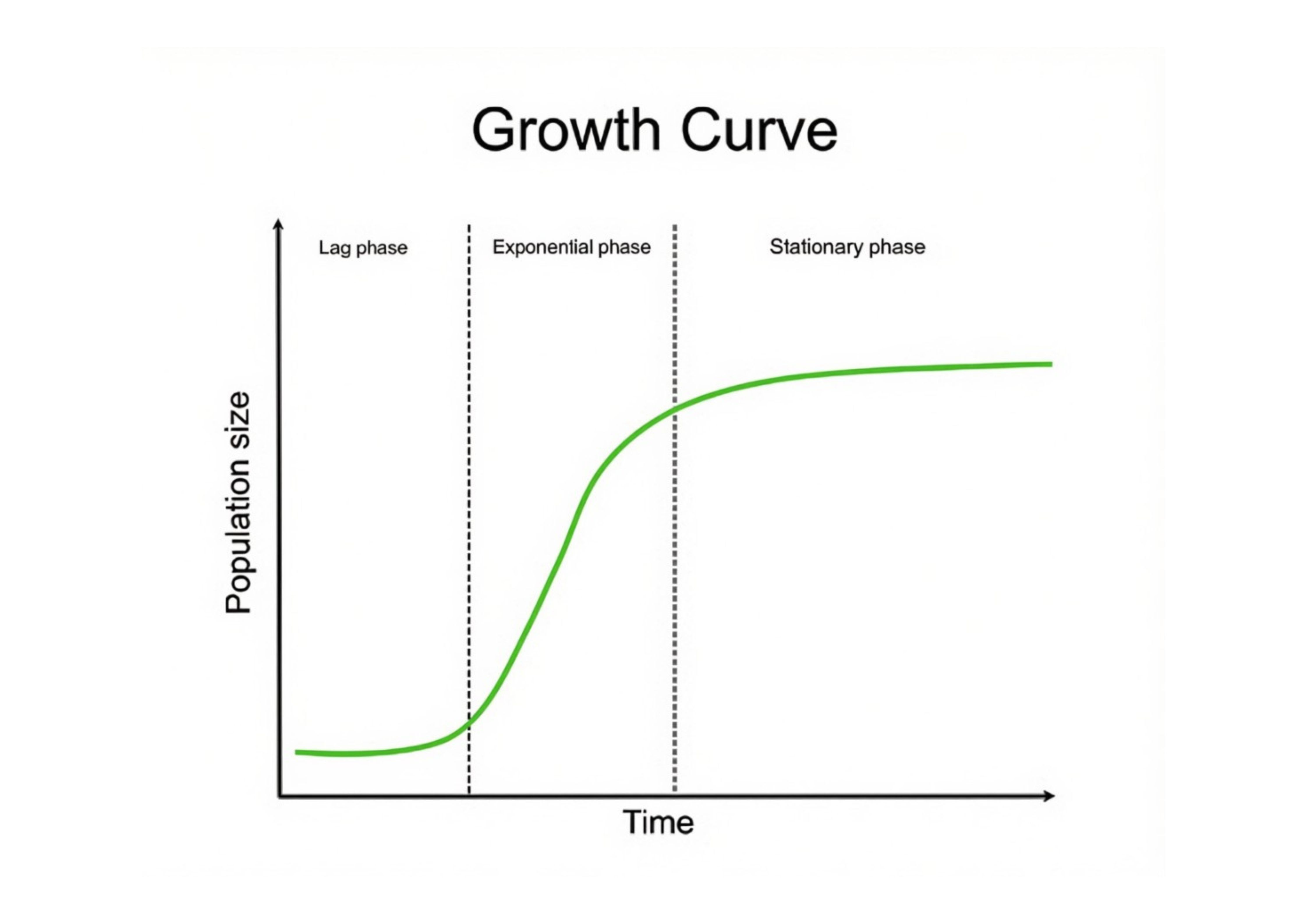
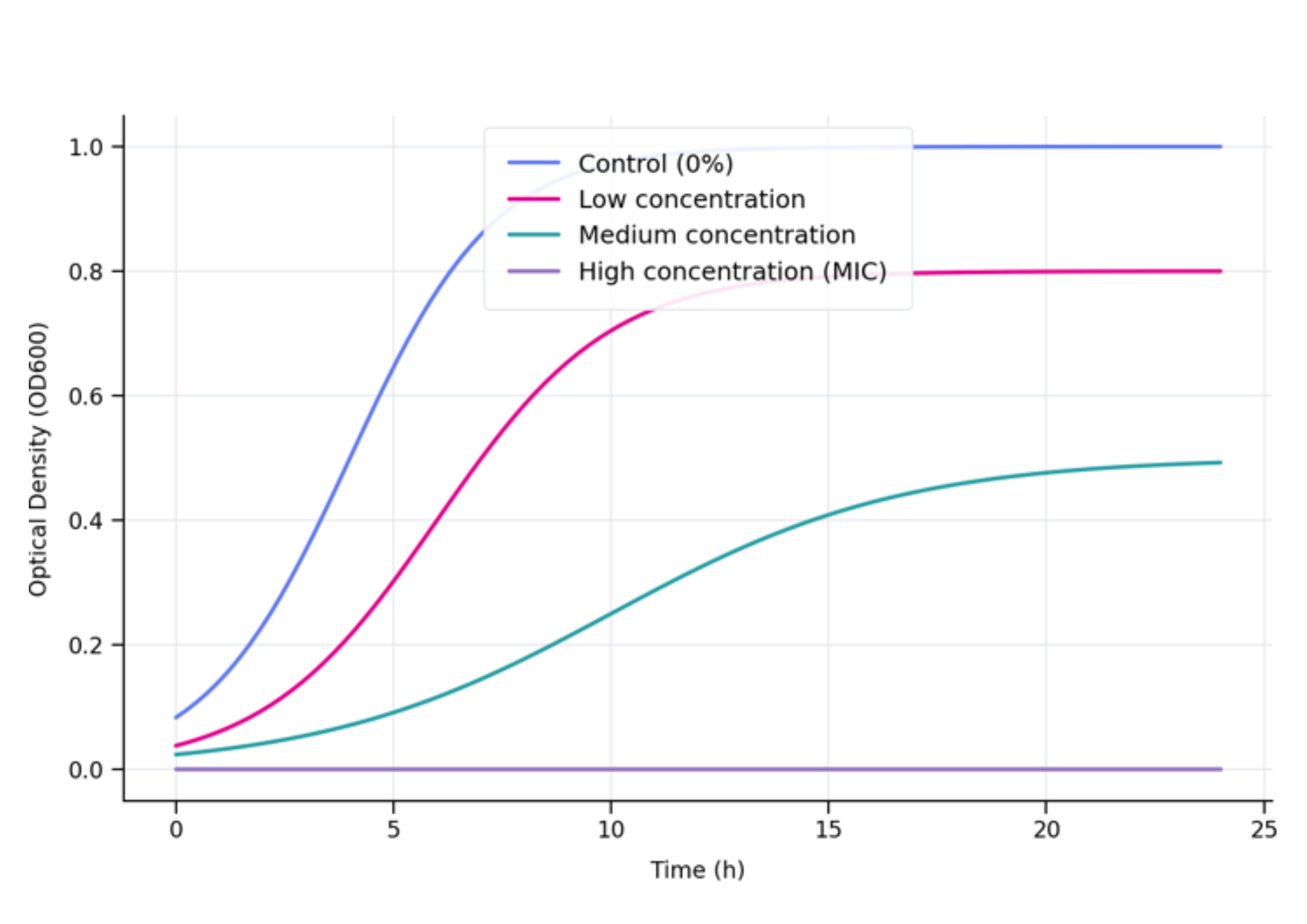
In the turbidity-based technique, efficacy is demonstrated by an increase in the duration of the lag phase, a decrease in the slope of the growth curve, and a reduction in the quantity of microorganisms present in the medium at a given time. Figure 2 shows the typical effects of a preservative on the growth curve from 0% till the Minimum Inhibitory Concentration (MIC) needed to fully halt microbial growth.
Real-life case studies
For non-pathogenic microorganisms, there are banks where we can obtain specific strains of interest based on the needs of food producers. We have already evaluated the MIC of several of our natural bio-sourced preservatives on some specific microorganisms like Pseudomonas fluorescens, Brochotrix thermsphacta, and Weissella helinica.
For pathogenic bacteria, it is a bit more complex to source them and work with them in the laboratory since they require specific precautions, certifications and present an elevated handling risks for employees. For this reason, Galactic’s R&D center is working on identifying non-pathogenic variants called surrogates, able of reproducing the growth characteristics of the pathogenic version as closely as possible. We have already developed a technique using Listeria innocua, a well-known surrogate of Listeria monocytogenes, to demonstrate the inhibitory effectiveness of many of our preservatives against this harmful bacterium. Figure 3 shows the impact on the growth curve of Listeria innocua as determined by turbidity measurements by using our Galimax Flavor V-50, an acetate-based fermentate, known as (buffered) vinegar.
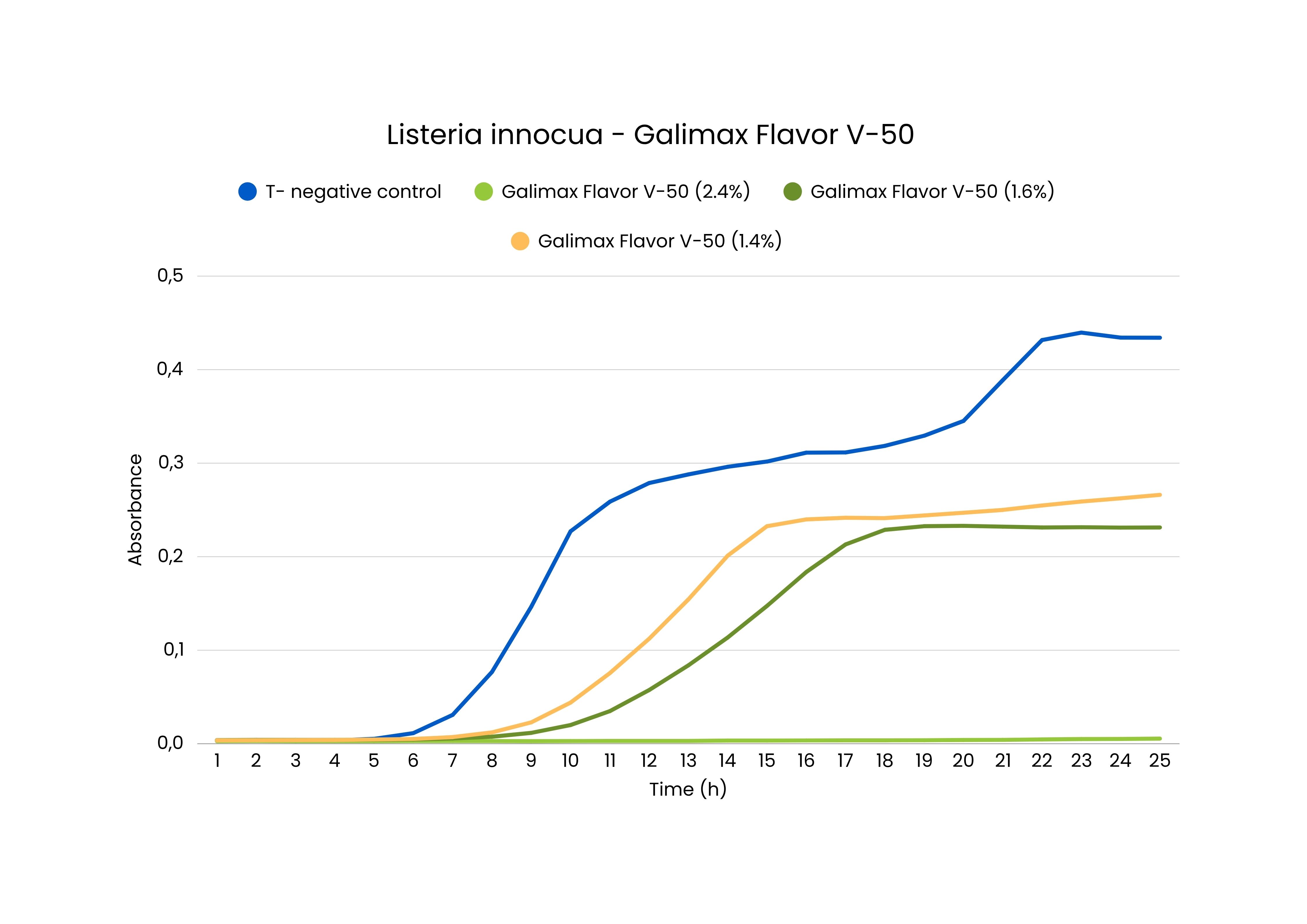
We can see that the MIC for a period of 24h for our flavor V-50 is reached at a concentration of 2,4% in the media. Furthermore, a significant inhibition can also be observed at a dosage from 1,4 to 1,6% as seen from the increased lag phase, reduced slope of exponential phase and the lower bacteria concentration after 24h incubation.
Similarly, the MIC of Galimax Flavor V-50 at 24h of incubation was determined for a surrogate of E. coli O157-H7, namely E. coli K-12. We can see here, at a concentration of 2,8% in the media, we have a full inhibition of the surrogate of E. coli O157-H7 for 24h (see Figure 4).

Based on in-vitro techniques and our high expertise in food microbiology, we can help food manufacturers to ensure good microbial safety in their food products. Where the in-vitro techniques help to rapidly identify interesting preservative candidates against targeted microorganisms, our application labs can in a second stage incorporate these solutions directly in food matrices and monitor the evolution of the responsible microorganisms. Let's talk! Our Sales and R&D Food Application teams remain at your disposal for any information.
Author: Alain Bernard, Corporate R&D Food Application Manager

Still have questions?
Can’t find the answer you’re looking for?
Contact us for expert advice and support!